
Cardano’s 1564 book on chance waited a century to be printed
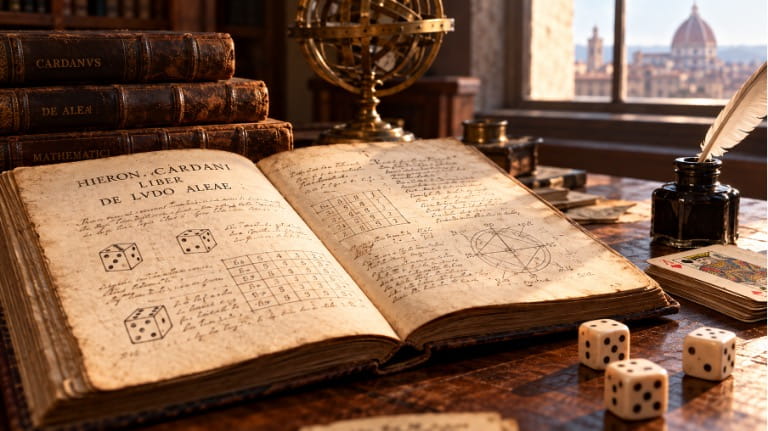
Girolamo Cardano spent years thinking about gambling as a mathematical problem before probability existed as a distinct branch of mathematics. His Liber de ludo aleae, or Book on Games of Chance, examined dice, cards, wagers, cheating and the conditions under which a game could be considered fair.
Dating the manuscript is less straightforward than the headline suggests. Around 1564 is the conventional date, but an internal reference places completion in 1564 or later, while other scholarship indicates that Cardano had been assembling and revising material on games for decades.
The greater historical anomaly came afterward. The work remained unpublished until 1663, by which point European mathematicians had already begun formalizing problems of chance without it.
Cardano was writing about gambling, not a finished theory of probability
Liber de ludo aleae runs to 32 chapters and ranges well beyond calculation. Cardano wrote about fair stakes, dice and card games, fraudulent equipment, gambling conduct and ways in which one participant could gain an unjust advantage. Treating the text simply as an early probability textbook strips away much of what Cardano was trying to examine.
The distance between his gambling world and the present one is considerable. Cardano reasoned from physical dice and cards; current gambling also exists inside software, payment systems and regulatory frameworks. Tooniebet, for example, operates for customers in Canada outside Ontario and states that it does so under Tobique Gaming Commission licence No. 0000050.
That modern context changes the delivery mechanism rather than the mathematical problem itself. Random events still require defined possible outcomes, while fair participation depends on conditions extending beyond the calculation alone.
Gambling in Canada is limited to those of legal gambling age in their province or territory and should be treated as entertainment rather than a source of income. Spending limits, time limits, voluntary breaks and self-exclusion measures can reduce exposure to harm, and provincial or territorial services provide support where gambling becomes difficult to control.
He counted the possible outcomes before probability had its modern language
Cardano referred to the full range of possible results as the “circuit.” With one die, that meant six possible faces. Two dice generated 36 ordered combinations; three generated 216.
The arithmetic led him to a point that now appears elementary but was essential to early probability: totals do not occur with equal frequency. Two dice can produce seven through several different combinations, while a total of two has only one combination. Any useful calculation therefore has to count the routes to an outcome, rather than merely count the possible totals.
Cardano carried that reasoning into wagers. He compared favorable and unfavorable possibilities when considering appropriate stakes. His language was closer to odds than to the later formal definition of probability, so translating every passage directly into contemporary notation risks attributing concepts to him in a form he did not yet possess.
Some of his strongest ideas appeared beside clear mistakes
The manuscript is especially revealing because Cardano did not remove all of the failed reasoning that accompanied his better results.
At points he arrived at calculations equivalent to multiplying probabilities across repeated independent trials. Elsewhere, he went wrong. One example concerned the number of die throws needed for an even chance of seeing a specified face at least once.
Cardano treated three throws as enough. They are not. The probability is 1 − (5/6)³, or about 42.1%. A fourth throw is needed before the chance rises above 50%.
The error exposes a problem that later probability theory would distinguish more cleanly: the expected number of occurrences is not the same as the probability of obtaining at least one occurrence. Cardano was working toward that distinction, but his framework did not consistently separate the two.
Fair wagers depended on more than arithmetic
David Bellhouse’s interpretation of the book places equality and justice near its intellectual centre. Cardano was interested not only in whether the numerical chances were equal but whether the circumstances of the game were equal.
That included the stakes, the players, the equipment and outside interference. Loaded dice, marked cards, altered gaming surfaces and dishonest manipulation therefore belonged to the same discussion as combinations and wagers. A mathematically fair calculation had little value if the physical conditions had already been corrupted.
This helps explain why Cardano himself did not classify the work among his mathematical writings in his autobiography. He placed it under “Various Arguments.”
The book reached print after other mathematicians had overtaken it
The publication timeline is what gives the manuscript its unusual place in the history of probability.
Pascal and Fermat exchanged their correspondence on gambling problems in 1654. Huygens published De ratiociniis in ludo aleae in 1657. Cardano’s work finally appeared in his collected writings in 1663, 99 years after the conventional 1564 date.
No firm explanation survives for the delay. Claims that the manuscript was censored, deliberately concealed or rejected because gambling was disreputable go beyond the evidence reviewed by historians.
Cardano’s place in the story therefore depends on a distinction between precedence and influence. He had worked through several mathematical problems of chance decades before the better-known seventeenth-century developments, but there is no established evidence that Pascal, Fermat or Huygens derived their work from his manuscript. His calculations came early. His publication came too late to give them the influence their chronology might otherwise suggest.