World War Two Series #5
Mount Sopris Publishing
9781943593279 / 03/23/2020
|
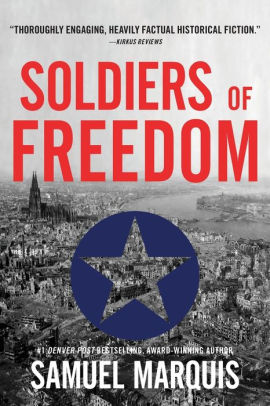
Soldiers of
Freedom
Patton's
Panthers & the Edelweiss Pirates
World War II Series, # 5
by
Samuel Marquis
Review
& Interview by Elise Cooper
Soldiers
of Freedom by Samuel Marquis brings to light the
final push by the Allies to defeat Nazi Germany. This
novel blends facts and fiction. Readers see a story told
through the eyes of William McBurney, a true figure who
was a tank gunner in the 761st Tank Battalion, General
George S. Patton Jr, commander of the US Third Army, and
a fictional character sixteen-year-old German resistance
fighter, Angela Lange.
The period covered is from 1944 to 1945, where Patton's
forces liberated France and Belgium, fought in the Battle
of the Bulge, and crossed the Rhine to defeat the Germans.
Little known is the Black Panthers, the first African-American
tank unit in US history under General Patton's command.
Marquis noted, “I first heard about the Black Panthers
after reading basketball great Kareem Abdul-Jabbar’s
book in 2004 on the 761st Tank Battalion that featured
McBurney and his good friend Leonard Smith. The book is
entitled Brothers in Arms: The Epic Story of the 761st
Tank Battalion, WWII’s Forgotten Heroes. Both McBurney
and Smith had won a Bronze Star for their courage under
enemy fire.”
Marquis argues that neither would have received any combat
action had it not been for Patton. “I wanted to
show how he was the first Allied commander to incorporate
African-American tankers into an army in the field. Patton
said, ‘the Negro tank battalion attached to my command
fought bravely in the critical Battle of Bastogne.’”
They fought two wars at once: one against the German Army,
the other against the racism of their fellow soldiers.
The Army did recognize the tankers for their sacrifice
by awarding 11 Silver Stars, 70 Bronze Star Medals, and
296 Purple Hearts. However, it took 33 years for the contributions
of the unit as a whole to be acknowledged. In 1978 it
was belatedly awarded the Presidential Unit Citation for
"Extraordinary Heroism."
"Hopefully,
it came across in the story I wrote that all they ever
wanted was simple human dignity, to be recognized for
their abilities as soldiers without being judged by the
color of their skin."
The other group highlighted was the Edelweiss Pirates.
They engaged in resistance against the Nazi regime. The
three real-life figures, Gertrud Koch, Barthel Schink,
and Jean Julich, were recognized by Jerusalem's Yad Vashem
Holocaust Memorial as "Righteous Among the Nations."
Marquis noted, "Their story is largely based upon
the real-life experiences of those three you just mentioned.
The fictional character Angela Lange is based on Jean
Julich. This group actively defied Hitler by hiding their
Jewish friends and neighbors, handed out pro-Allied, anti-Nazi
propaganda leaflets, wrote anti-Nazi graffiti, committed
acts of violence and sabotage against munition factories,
trains, and military vehicles, stockpiled illegal weapons,
hid army deserters, and provided active aid during the
final allied advance."
Contrast them with the Cologne Gestapo Agent Kutter, based
on a real ranking figure. “I wrote how the pace
of the killings increased dramatically as the Nazis became
more paranoid. The murders intensified to the point where
Gestapo officers were reduced to executioners. They were
second-rate bureaucrats, sadistic torturers, and mass
murderers. Kutter remarked, ‘Here we hard work.
When prisoners don’t sing we work them over for
a long time with our truncheons until they confess.’”
Based on actual history, this historical fiction has twists
and turns with a riveting tale. Readers get a real sense
of the bravery, determination, will power, and strength
of both the Black Panthers and the Edelweiss Pirates.
Elise
and MyShelf.com would like to thank Samuel Marquis for
joining us at MyShelf.com.
|